
Introduction: Why Multi-Account Strategy Is Infrastructure Security
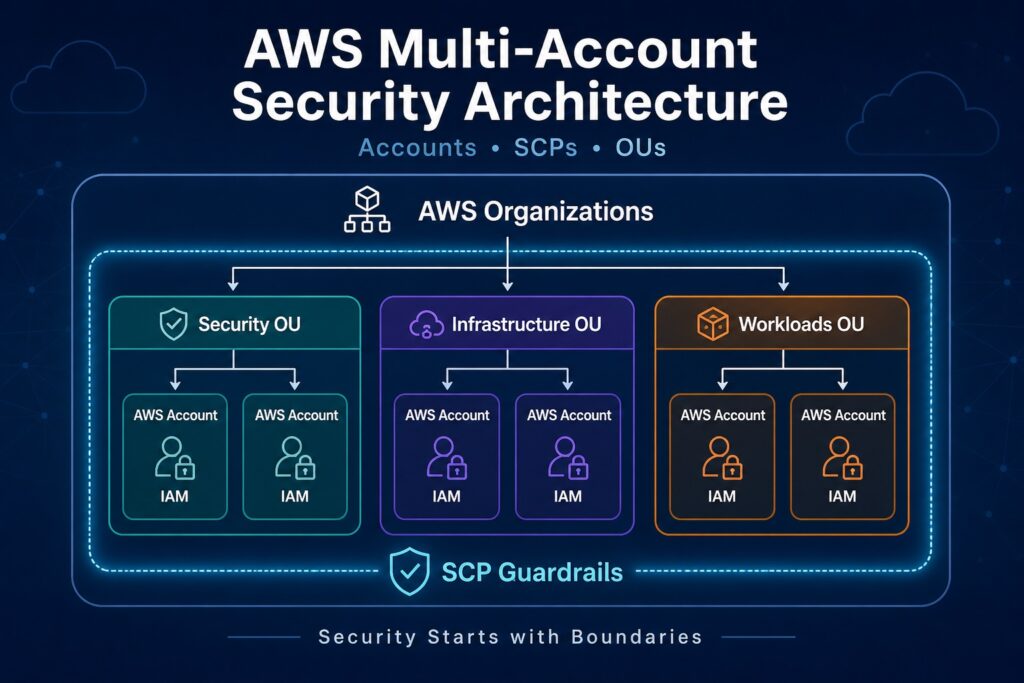
There is a common perception that AWS revolves around IAM policies, roles, and permissions that perform authentication and authorization. However, these services form just one layer of the AWS security architecture, with layers below enforcing security by design that these services support. These layers compartmentalize the AWS network through network segmentation and access through boundaries. These boundaries are AWS Accounts, and they are further supported by AWS Organizations, with SCPs that establish access guardrails for these boundaries.
These internal trust boundaries must also extend to hybrid connectivity patterns that connect enterprise environments to AWS. For example, understanding the security implications of private circuits and encrypted transport is critical when evaluating AWS VPN vs Direct Connect Security. Therefore, security architecture defines these boundaries, and IAM operates within those boundaries. Understanding how identities, roles, and permissions operate within these security boundaries is equally important for controlling access to AWS resources at scale. For a deeper discussion, see AWS IAM Architecture: Designing Identity Boundaries at Scale. For a broader, architecture-first perspective, see AWS Infrastructure Security: Why Architecture Comes First.
Security Through Boundaries and Blast Radius Reduction
Compartmentalizing access through AWS accounts reduces the shared blast radius, so compromised workloads cannot impact workloads in other accounts. This follows the principles discussed in AWS Resource Isolation Security, where isolation boundaries contain failures and limit lateral movement.. A single large account creates an unbounded blast radius, where compromised resources can impact other systems within the same account. Causes include misconfigurations, privilege escalation, and lateral movement. AWS Organizations allow far more fine-grained boundary control by grouping accounts into structured security domains, with SCPs defining guardrails.
Implementing a multi-account strategy makes security control implicit in the AWS ecosystem by controlling workloads’ access to resources in other accounts. AWS Organizations with SCPs provide another layer of control, with SCPs acting as guardrails for the authentication and authorization layer. This article explains how boundaries make security control implicit in AWS, why IAM alone is insufficient, and how SCPs enforce defense in depth at scale.
Why AWS Accounts Are Your Primary Security Boundary
AWS Accounts serve a greater role than billing containers or a logical grouping of resources with a common purpose. They serve as a security boundary by defining the IAM namespace and resource ownership, forming the strongest boundary unit within AWS. Lower-level controls, like network boundaries that segment connectivity, are weaker than account boundaries, which segment access. Account boundaries further define access and ownership, isolate resources, and establish a blast radius for compromised workloads.
Isolation as a Security Primitive
AWS Accounts serve as a hard boundary around workloads and resources by denying implicit access. This represents resource isolation as a foundational security control, establishing trust boundaries that separate workloads and reduce blast radius. Each account has a separate namespace where users, roles, and policies are not shared between accounts. Additionally, ownership of resources within an account is not available to other accounts, so there is no implicit cross-account access. Significantly, AWS sets up a separate control plane for each account, so all API actions are scoped to that account. Hence, there is no implicit access between accounts, since AWS makes isolation inherent rather than configuration.
VPCs are the fundamental unit of network segmentation, but are weaker than account security boundaries. Network segmentation occurs at the L3/L4 layer, which is agnostic of traffic context and whether it is unauthorized or harmful. When resources between VPCs share the same account-level IAM and control plane, then they are not isolated at the identity/control level. Also, misconfigurations can bypass VPC boundaries because these boundaries are context-agnostic.
Blast Radius and Failure Domains
AWS Accounts are based on the same concept of watertight compartments on a ship. Whenever resources within an account become compromised, the account boundaries prevent them from affecting resources in other accounts. Compromised credentials or misconfigurations can allow malicious actors to take control of resources. Separate access boundaries defined by AWS Accounts contain these contaminated resources; thereby, accounts define failure domains. This becomes particularly important when securing compute workloads across EC2, ECS, and EKS environments. For a detailed comparison of how isolation, orchestration, and shared responsibility differ across AWS compute platforms, see EC2 vs ECS vs EKS: Why AWS Compute Security Isn’t the Same.
There are several real-world examples that illustrate the role of AWS Accounts in making security implicit throughout the AWS ecosystem. The most common example is development vs production isolation, where experimental software in the development Account does not impact resources in Production. Another common example is security tool accounts that are isolated to prevent exposure of logs and security resources from other workloads. Therefore, separation is intentional and not accidental.
Aligning Accounts to Workloads and Trust Zones
AWS Accounts typically group workloads and resources that have a common purpose or mission, cleanly isolating resources with different functionality. A common grouping is by applications or domains, where resources that form a software application include web servers and databases. Another dimension of separation is environments, such as dev/test/prod, that prevent developmental and untested applications from affecting production systems.
AWS Account isolation is also elevated to the enterprise level, which separates trust between different segments. These include regulatory isolation, which prevents sensitive data from being exposed to workloads in other accounts. Finally, AWS Accounts also enforce trust boundaries by isolating resources at different trust levels, preventing external access to sensitive internal systems. These trust boundaries become especially important in hybrid architectures where enterprise networks connect to AWS through VPNs or dedicated circuits. For a deeper discussion, see AWS VPN vs Direct Connect Security: The Security Trade-offs That Actually Matter.
AWS Organizations SCP: Preventive Security at Scale
AWS Accounts define access boundaries for groups of resources, but do not define what is allowed within those boundaries. Service Control Policies (SCPs) can be applied to AWS Accounts and OUs to restrict what is allowed within those boundaries. Therefore, while AWS Accounts isolate resources from other entities, SCPs restrict actions across accounts and across organizations. SCPs are preventive controls that are applied at scale.
What SCPs Are (and What They Are Not)
An AWS Organizations SCP specifies restrictions on actions by entities within an AWS Account. This extends to accounts within an OU when an SCP is applied to that OU or parent OU. As a result, they enable system administrators to apply organization-level policies across all the AWS Accounts within the organization. They set the maximum allowed actions and define the outer permission boundary encircling AWS Accounts.
A common misconception regarding SCPs is that they allow or permit actions. SCPs only restrict and establish guardrails across AWS Accounts and do not grant permissions. In practice, AWS Accounts still require IAM to grant permissions to entities through policies associated with users or roles they assume. SCPs can override these granted permissions and act as a filter and not as an enabler.
SCP Evaluation Model Simplified
AWS evaluates policies to determine whether an entity is permitted to perform a particular action. Hence, the most important rule is the SCP’s explicit deny that prevents performing an action even when other policies allow it. Therefore, the explicit deny overrides everything when AWS evaluates whether to grant permission to an entity. As a result, it denies regardless of roles since a malicious actor could hijack any role to compromise permissions.
Since AWS evaluates permissions by applying both SCP and IAM policies, AWS evaluates permissions based on the intersection of SCP and IAM policies. In other words, an action must be permitted by both SCP and IAM for an entity to be allowed to perform it. In practice, SCP acts as the guardrail by narrowing the IAM permission space for actions by entities on resources within the AWS Account.

Why SCPs Matter for Security Architecture
Security architecture’s main goal is to make security implicit in the AWS ecosystem through network segmentation and permission boundaries. However, there is the risk of misconfigurations of authorization within different permission boundaries, weakening their effectiveness. Architects address this through SCPs that enforce guardrails globally, overriding any misconfigurations within permission boundaries established by AWS Accounts. This works across accounts and teams and enforces consistency across the AWS ecosystem.
Examples of applying restrictions through SCPs include ensuring actions are only scoped to regions and cannot be performed in other regions. An even more important restriction is access to critical services by entities that SCP policies enforce. This is even when such access is allowed by IAM policies. Finally, they provide immutable rules that cannot be overridden by IAM. These controls complement edge protections such as AWS WAF, Shield, and CloudFront.
Designing Organizational Units for Security and Blast Radius
Organizations of sufficient scale typically have many AWS Accounts that can be grouped into common functional areas, often aligned to product domains. These account boundaries can fall within a larger boundary defined by an Organization Unit (OU) that they are members of. AWS Organization SCPs are applied to OUs to restrict actions across those OUs, enabling centralized control and consistent guardrail distribution across member accounts.
OU Hierarchy Patterns
Another boundary management mechanism is that OUs can belong to other OUs, forming a logical hierarchy of boundaries. At the top is the Root OU that implements global guardrails through SCPs, with its member OUs representing the key control domains. First is typically the Security OU that includes security and logging accounts with strict SCPs to prevent tampering and enforce immutability. Next is the Infrastructure OU, which provides shared services that workloads access in a controlled manner. Finally, there is the Workloads OU, which owns the application accounts implementing business logic, where AWS Organization SCPs enforce least privilege and operational constraints.
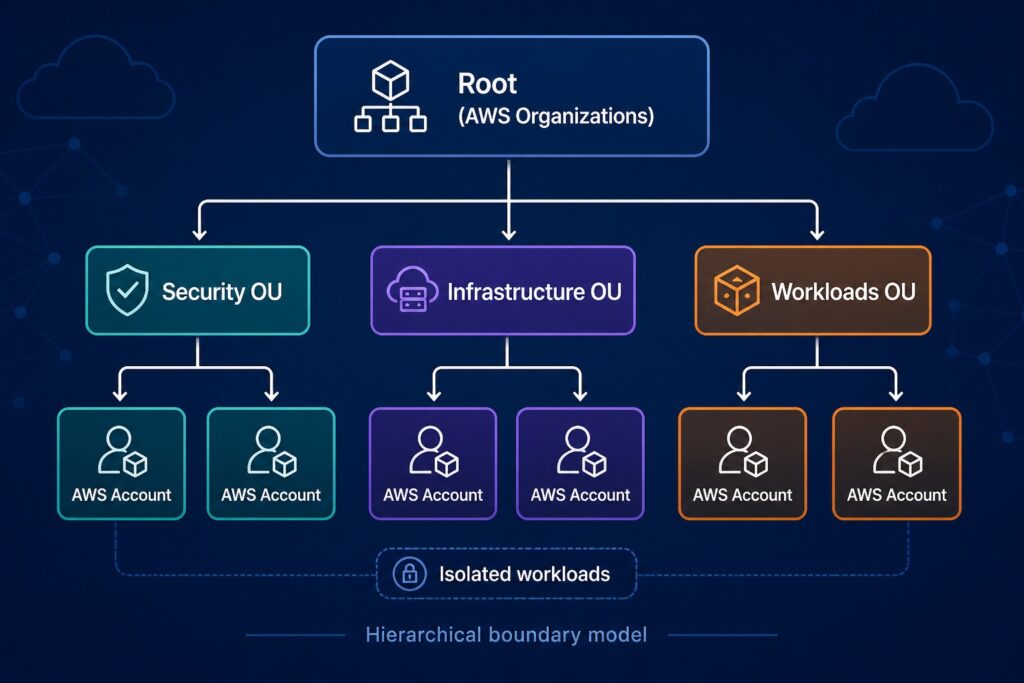
These control domains are further divided into environments such as development, quality control, and production. Each environment serves a distinct role in the application lifecycle and acts as an isolation boundary. This separation ensures that changes in development and testing do not impact production systems, limiting the blast radius of potential issues or security events.
Policy Inheritance and Guardrail Placement
Throughout the OU hierarchy, member OUs inherit the SCP from their parent OU, where restrictions apply to all OUs and accounts under it. Therefore, any SCP restrictions from the root OU will flow down to its member OUs. These restrictions propagate down the hierarchy to all member OUs and their accounts. Consequently, good architectural principles should establish broad guardrails at higher levels and apply tighter controls at lower levels. Broader guardrails at higher levels also maximize consistency across all accounts, ensuring uniform security and preventing unprotected accounts. Additionally, they prevent AWS Organization SCP drift across accounts by restricting their changes within accounts. This also includes ensuring that certain guardrails always apply across all accounts without the need to check each account. Examples of broad guardrails are region restrictions, logging requirements, and critical service protections.
Because SCP changes can affect every account within their scope, teams should manage these policies through version control, peer review, testing, and staged deployment with rollback capability. These practices are explored in Security Automation in AWS: Guardrail Engineering at Scale, which explains how to manage guardrails throughout their lifecycle.
Common OU Design Mistakes
However, good OU design is critical to ensure that the hierarchy is effective in managing guardrails across the ecosystem. There are several poor design choices in the OU hierarchy that make guardrail management more difficult and increase the risk of security gaps.
Having a flat structure with no control layering results in duplicating guardrails across similar account types, such as security. This can cause fatigue and introduce serious gaps. Over-centralizing guardrails in a single OU forces frequent updates to keep pace with evolving requirements, creating bottlenecks when reviewing updates. Also, mixing environments results in mixed workloads, leading to confusion and poorly designed guardrails that can expose security gaps.
AWS Organization SCP Guardrails in Practice: Real Security Controls
AWS Organization SCPs are central to establishing guardrails and strengthening boundaries across the AWS ecosystem. They enforce invariants across OUs and AWS Accounts, restricting actions regardless of IAM permissions granted through misconfigurations or malicious activity. We now explore several critical areas where SCPs enforce non-negotiable rules to prevent security gaps from introducing unacceptable risk.
Region Restriction
AWS Organization SCPs can prevent the deployment of resources to AWS regions that are not approved. There are several critical reasons, including preventing shadow deployments by bad actors, with cryptocurrency mining as a significant example. Another important reason is data residency issues with jurisdictions like the EU. The EU stipulates that the personal data of EU citizens must never reside in regions outside the EU. Therefore, SCPs enforce the location of workloads and data as a security control.
Service Restrictions
Another critical area for AWS Organization SCPs is restricting services that are either risky or not required by business processes. Restricting these services further reduces the attack surface since malicious actors are denied from using these services to attack workloads. Since there are a plethora of AWS services, allowing all services increases the attack surface, making control harder to manage. The SCP hierarchy enables finer-grained control by allowing different business domains to permit only the AWS services they require.
Preventing Privilege Escalation
This is by far the most critical activity to protect, since allowing malicious actors to elevate their privileges can give them free rein, with catastrophic consequences. Therefore, SCPs should deny IAM modifications and policy changes that would give privilege escalation to users and roles. SCPs restrict privileges to these roles to what is required to perform their tasks. Even more critically, SCPs restrict access to admin roles and root privileges, which together provide almost complete control over AWS accounts and their resources. Therefore, the most important role of SCPs is locking down the control plane.
Enforcing Logging / Security
This is the next most critical activity to protect, since logs are vital to any security event detection and investigation. These include AWS-native logging, monitoring, and threat detection services, such as CloudTrail, CloudWatch, and GuardDuty, that detect anomalies that may reveal security events. Disabling any of these services, even briefly, can allow attacks to go undetected and lead to serious incidents with significant impact. Therefore, guardrails through SCPs must prevent any disabling of logging due to either malicious actors or misconfiguration. Additionally, AWS Organizations SCPs must restrict any actions that could modify or delete logs. For a focused comparison between AWS-native monitoring and enterprise observability platforms, see CloudWatch vs Datadog.
Further Learning: If you want to go deeper into AWS security architecture, multi-account governance, and practical guardrail design, structured learning can help reinforce these concepts.
Disclosure: Some links on this page are affiliate links. As an Amazon Associate, AI Cloud Data Pulse earns from qualifying purchases. We also participate in the Pluralsight affiliate program and may earn a commission if you subscribe or purchase through our links, at no additional cost to you. We only recommend courses and resources that provide genuine value to our readers.
For book-based study, consider an AWS Security Cookbook or Architecting for Scale that covers IAM, AWS Organizations, logging, monitoring, and governance patterns.
For hands-on learning, platforms like Pluralsight can help you practice AWS security concepts through guided courses and labs.
Centralized vs Delegated Security Models
Centralized Model
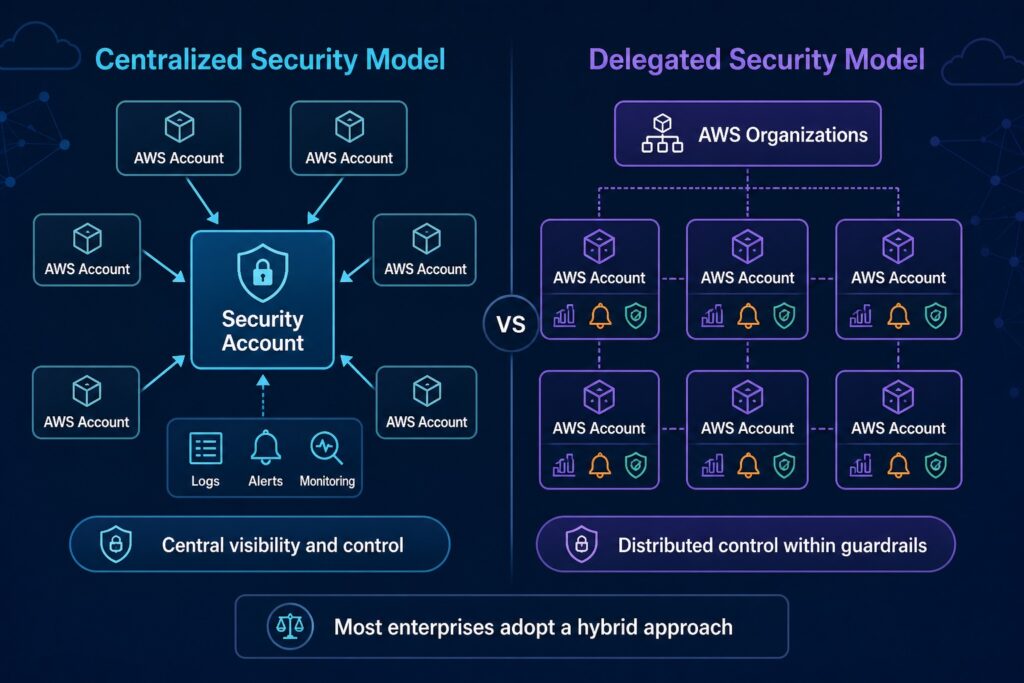
Security architecture starts with boundaries and AWS Organization SCPs, but requires active security management whenever attackers penetrate those boundaries. Many architectures support a centralized security account model with a dedicated AWS account responsible for security operations, with access restricted through strong SCP guardrails. It manages observability data across all AWS accounts, including logs from CloudTrail and configuration data from AWS Config. This data is typically held in S3 buckets for long-term retention and audit. The security account also typically uses GuardDuty to aggregate findings centrally and Security Hub to consolidate and correlate alerts.
This model provides centralized visibility across all accounts, easier correlation of events and anomalies, and consistent enforcement of security policies. However, configuration is more cumbersome, which can slow response times for urgent fixes and lead to bottlenecks. Organizations implementing centralized security operations often require broader observability capabilities across AWS environments. For a detailed comparison of AWS-native monitoring and enterprise observability platforms, see CloudWatch vs Datadog.
Delegated Security Model
To address the configuration burden, another approach to security management is to establish delegated administrator AWS Accounts. AWS Accounts are designated as delegated administrators for services such as Security Hub and GuardDuty. As a result, these services can operate without requiring full control from a single security account. This aligns with the AWS Organizations model for scalable governance, enabling application teams to retain control of their own accounts. Furthermore, it allows AWS Organization SCPs to enforce boundaries while allowing operational flexibility. This gives teams the flexibility to configure services and respond to incidents locally, thereby removing bottlenecks caused by central approval.
Trade-offs
Centralized control provides consistent enforcement of security policies across all accounts with central visibility for logs, findings, and compliance. Furthermore, it reduces the risk of misconfiguration and establishes clear ownership and accountability. However, delegated management enables teams to operate their own accounts within defined guardrails, allowing for faster response to operational and security events. In practice, many organizations adopt a hybrid model by centralizing governance, visibility, and compliance. However, they delegate execution, agility, and domain ownership to application teams.
AWS Control Tower: Accelerating Secure Multi-Account Setup
Multi-account environments require core management and security accounts to support effective boundary design. AWS Control Tower Landing Zone preconfigures these environments as part of an AWS Secure Landing Zone, establishing a standardized multi-account foundation with integrated identity services to reduce misconfiguration. It also provides default OU structures, typically including Security, Infrastructure, and Workloads, along with their associated guardrails. Hence, it establishes predefined guardrails implemented via SCPs and enforces common controls.
AWS Control Tower’s key benefit is automating the setup of multi-account environments, thereby reducing the manual configuration effort. This standardizes the initial governance structure and reduces the risk of misconfiguration. As a result, it establishes baseline security controls quickly for new AWS environments and early-stage cloud adoption. However, architects must build on top of this to establish guardrail placement and operating models.
However, AWS Control Tower is highly opinionated and prescribes the default OU structure and guardrails. This may not align with complex enterprise needs since it assumes standard use cases. This is further exacerbated since it is difficult to customize deeply, as modifying default structures may be restrictive. Also, advanced requirements may require additional SCPs and manual adjustments, making this less flexible for highly specialized architectures.
Common Pitfalls in Multi-Account Security Design
Security starts with architecture and well-designed AWS Organizations SCPs, yet many engineers over-rely on IAM. For a detailed exploration of IAM design principles, see AWS IAM Architecture: Designing Identity Boundaries at Scale. They are often used in place of architectural boundaries, granting access to resources where it is not required. They can also replace guardrails, requiring engineers to enforce controls manually. This can result in errors, misconfigurations, and security gaps. Additionally, they can treat SCPs as permissions, negating their role as guardrails and overly permissive accounts that expose security gaps. These risks become even more important in containerized and orchestrated compute environments, where responsibility boundaries differ significantly between EC2, ECS, and EKS. For a deeper breakdown, see EC2 vs ECS vs EKS: Why AWS Compute Security Isn’t the Same.
OU design helps decentralize multi-account environments by establishing guardrails, allowing application owners to configure their accounts. However, poor OU design undermines cloud architecture by failing to delineate AWS Accounts with specialized roles. An example is not properly isolating logging from other workloads that do not require access to logging. Logs critical for security are exposed to deletion and tampering, making the AWS environment highly vulnerable. Even if access is limited to only reading logs, malicious actors could gain valuable insight into how to attack applications.
AWS Organizations SCP: Conclusion
Security starts with architecture, with AWS Accounts establishing the primary boundary topology and IAM operating within those boundaries. Multi-account design forms the foundation, while OUs organize these accounts into a hierarchy that supports decentralized governance. AWS Organizations SCPs act as guardrails, serving as the primary controls that restrict actions across accounts.
This architecture enables secure scaling by using accounts to isolate workloads and reduce blast radius. SCPs enforce these boundaries by restricting access and preventing misconfigurations, while OUs organize accounts and enable dedicated security functions to operate across the environment. Together, these elements create a security model where controls are embedded by design rather than enforced reactively. The same architectural principle applies to hybrid networking, where private connectivity alone is not a security model. Security still depends on clearly defined trust boundaries, segmentation, encryption, and explicit controls, as discussed in AWS VPN vs Direct Connect Security. This architecture-first approach is fundamental to building secure AWS environments at scale.
